
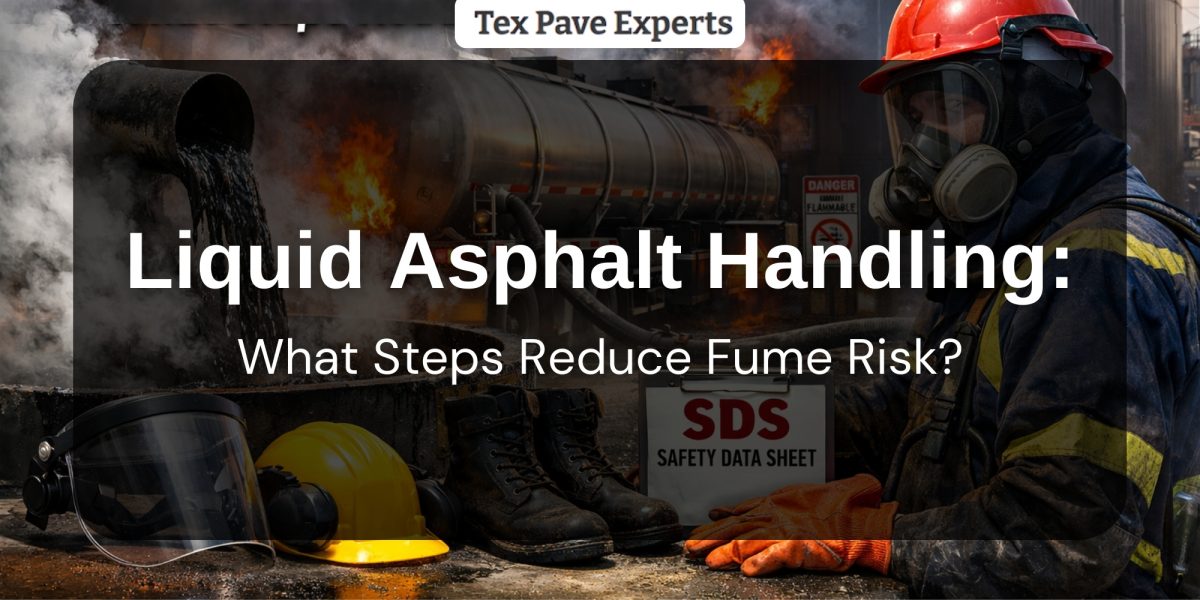
Liquid Asphalt Handling: What Steps Reduce Fume Risk?
Liquid Asphalt Handling is a concept where a Liquid asphalt (bitumen) is the thick, sticky binder used in asphalt paving and roofing. It becomes workable only when heated to high temperatures – typically 150 °C-200 °C, which allows pump‑ability and mixing with aggregates. When hot, asphalt emits vapors containing light hydrocarbons and hydrogen sulfide; if heated beyond its flash point or exposed to ignition sources, these vapors can combust. Workers exposed to asphalt fumes may suffer eye and respiratory irritation, headaches and skin burns. Because asphalt is derived from petroleum and cutback asphalts contain volatile solvents, cutback and rapid‑curing products are specifically labeled as flammable and fire hazards. Protecting people and property therefore requires strict attention to handling practices, personal protective equipment and site control.
As a North‑Texas paving contractor, Tex Pave Experts has over 35 years of experience delivering smooth, durable surfaces. Our team follows recognized safety guidelines and invests in well‑trained crews and modern equipment. In this guide we outline proven steps to reduce fumes and fire risk while doing liquid asphalt handling and explain how working with professionals keeps your project safe and on‑schedule.
Why Safety Matters for Liquid Asphalt Handling?
Two primary hazards accompany heated asphalt:
- Fire/explosion risk – Asphalt releases volatile gases when heated. If the temperature rises above the material’s flash point and a spark or open flame is present, vapors can ignite. Bitumen is considered a combustible material, and traces of light hydrocarbons off‑gas around 150 °C (300 °F) creating a flammable environment in storage tanks. Cutback asphalts are even more dangerous because the solvents used to reduce viscosity have flash points similar to gasoline.
- Health impacts of fumes – Inhaling hot asphalt fumes can irritate the nose, throat and lungs and cause headaches, nausea and dizziness. Exposure to hydrogen sulfide and other gases can lead to acute respiratory symptoms or long‑term lung diseases. Skin contact with hot asphalt or solvents causes severe burns and dermatitis.
Understanding these hazards is the first step in mitigating them. Contractors must control temperatures, avoid contamination, manage ignition sources and provide the right protective equipment.
Temperature control and flash points
Asphalt binder must be heated, but overheating increases fire risk. Manufacturers publish the flash point for each grade; staying well below this temperature prevents the vapors from igniting. When applying prime coats or cutback asphalt, the binder may be heated above its flash point; therefore distributors should be cleaned regularly and burners shut off before spraying. Some safety programs recommend using warm‑mix asphalt or slower‑curing products when possible. These mixes are produced at lower temperatures and reduce fume emissions and combustible vapors. Using asphalt mixes with higher flash points or less toxic solvents is another control method.
Avoiding contamination and boil‑overs
Water or incompatible materials inside tanks can cause violent boil‑overs when hot asphalt is pumped in. Workers should know the previous load carried by a tanker and check hatch covers for condensation; moisture or solvent residue can cause a flash fire. Storage tanks must have enough capacity to receive a new load, and drivers should ensure they are at the correct loading rack and that the brakes are locked and wheels chocked during filling. At asphalt plants, pump hot asphalt only into clean, dry tanks and never mix it with water, emulsions or cutback asphalts; mixing hot bitumen with water can lead to explosive steam expansion and tank failure.
Controlling Ignition Sources
A single spark can ignite asphalt vapors. To prevent accidental fires:
- Prohibit smoking, open flames and unprotected electrical equipment around asphalt operations. Post clear signage and designate fire‑hazard zones around storage tanks.
- Eliminate diesel torches used to thaw congealed asphalt; instead insulate pipes and use engineered heating systems or electrically powered blankets. Where torches must be used, employ lower explosive limit (LEL) monitors and ensure the area is rated for such work.
- Ground equipment and use non‑sparking tools when working around flammable liquids. Check that hoses and connections are in good condition to prevent sprays that could contact hot surfaces.
Ventilation and fume control
Because heated asphalt emits vapors and hydrogen sulfide, ventilation is critical. Local exhaust or enclosure reduces fumes at the work area; general dilution ventilation may supplement but is less effective. When mixing asphalt, avoid open kettles; enclose or automate mixing, or schedule the process when fewer workers are present. For roofers and small operations where enclosure is impractical, use portable fume extractors to pull vapors away from the breathing zone. Substituting warm‑mix or slower‑curing asphalts lowers production temperatures and reduces emissions.
Personal protective equipment (PPE)
OSHA requires employers to evaluate hazards and provide appropriate PPE. When liquid asphalt handling:
- Face and eye protection – Wear an 8‑inch minimum face shield or safety goggles to protect against splashes and fumes.
- Clothing – Wear long‑sleeved shirts with cuffs buttoned, long pants without cuffs, and thermally insulated gloves with gauntlets to protect against splashes. Coveralls provide full body coverage.
- Footwear – Use lace‑up safety boots (6 inches or higher) with trousers extending over the top to prevent hot asphalt from entering the boot.
- Respiratory protection – When ventilation cannot adequately control fumes, workers should wear a properly fit‑tested respirator with organic‑vapor cartridges and a full face mask. Dust masks are insufficient. Employers must implement a written respirator program.
- Barrier creams and lotions may help prevent skin irritation under protective clothing.
Safe loading, storage and unloading procedures
Drivers and plant workers must follow strict procedures when loading or unloading hot asphalt:
- Check manifests and inspect tanks for water or solvent residues. Any contamination can cause a violent eruption or degrade the product.
- Stand upwind and several feet away when loading to avoid inhaling fumes. Secure loading spouts to prevent them from lifting due to high‑volume pumps.
- Lock brakes, turn off engines and chock wheels during loading to prevent accidental movement.
- Ensure all covers and hatches are closed before moving the truck. At storage facilities, install hydrogen sulfide monitors; if the alarm sounds or a rotten‑egg smell is noticed, vacate the area immediately and stand upwind.
- Drain hoses and manually clean conveyors after unloading to prevent residual asphalt from igniting later.
Training and safety data sheets
Safety begins with education. Each worker handling asphalt should receive a Material Safety Data Sheet (SDS) explaining the product’s flash point, boiling point, chemical components, recommended PPE and emergency procedures. Employers must develop a written PPE program and train employees on hazard recognition, equipment maintenance and emergency response. Job‑site orientation should cover the location of fire extinguishers, eyewash stations and emergency exits. Tex Pave Experts invests in ongoing training, ensuring our crews know how to identify risks and act quickly if an incident occurs.
First aid and emergency response
Even with precautions, accidents can occur. Proper first aid reduces the severity of injuries:
- Fume inhalation: Move the affected person to fresh air immediately. If breathing is difficult or stops, call 911 and begin artificial respiration.
- Cold asphalt on skin: Remove the material gently with a waterless hand cleaner or warm mineral oil, wash with soap and water and remove contaminated clothing. Flush eyes for at least five minutes if asphalt contacts them.
- Hot asphalt burns: Apply cold water or an ice pack to cool the burn; do not attempt to remove asphalt from the skin. Seek medical attention immediately for all burns.
Partner with Tex Pave Experts For Liquid Asphalt Handling
In liquid asphalt handling safely it requires experience, specialized equipment and disciplined procedures. Tex Pave Experts brings decades of North‑Texas experience to every project. Our crews follow industry best practices for temperature control, tank inspection, fume management and PPE. We use modern equipment and warm‑mix technologies to reduce emissions, and we never cut corners when it comes to safety.
When you hire Tex Pave Experts for asphalt paving solutions, you get a partner who understands the science behind asphalt and applies it responsibly. Our asphalt patching and repair expertise ensures potholes are fixed safely and efficiently. If you’re exploring cost‑effective maintenance options, read our guide to asphalt overlay costs and see how resurfacing saves money compared with full replacement. Clients interested in sustainability can learn more about eco‑friendly asphalt options and modern paving techniques on our blog. We even break down whether asphalt is cheaper than concrete and explain why timing matters in our article on the best time to repave your driveway.
If you’re curious about the differences between hot mix and recycled asphalt or want to see how we serve specific communities such as Hawk Cove, our blog has detailed guides. We even share insights into industry innovations in our article on revolutionizing asphalt paving.
By choosing Tex Pave Experts, you’re not just getting a smooth, long‑lasting driveway or parking lot, you’re partnering with a company that prioritizes safety, quality and transparency. Contact us today on 9725697946 to discuss your project, request a free quote and experience the difference a professional asphalt contractor makes.
Concrete Paving Thickness: Which Thickness Works Best?
Concrete pavement works on a simple idea: a slab of engineered rock carries massive wheel loads by spreading them across a prepared base. If that slab isn’t thick enough, traffic loads cause the concrete to flex more than it can handle. Because concrete is strong in compression but relatively weak in tension, a thin slab under heavy vehicles develops tension cracks. Making the slab thicker gives it greater bending strength, spreads wheel loads over a larger area, and reduces tensile stress. A uniform, compacted base is equally important because it reduces differential movement and helps distribute loads.
This article explains how to choose the right slab thickness for different traffic loads. It combines engineering guidelines with insights from Tex Pave Experts, a full‑service paving contractor with decades of experience in concrete and asphalt. We’ll look at how traffic type, subgrade conditions, and climate influence pavement design, and offer practical recommendations for homes, businesses, and heavy‑duty applications. Throughout the article, you’ll find links to relevant service pages and blog posts on our site for deeper reading.
Why Concrete Paving Thickness Matters?
When you park a car on a concrete slab, the weight of the vehicle compresses the slab and causes bending at the bottom. For a thin slab, this bending creates high tensile stress at the bottom face of the concrete. Because concrete is not as strong in tension, the slab may crack and eventually fail. Increasing the thickness greatly improves the slab’s ability to carry tensile stress. In practical terms, a 1-inch increase in thickness can increase load‑bearing capacity by 50-100 %, so thickness is a very cost‑effective way to extend pavement life.
Thickness also affects joint spacing. The Pennsylvania Aggregates and Concrete Association notes that control joints should be 15 feet apart on an 8‑inch slab but only 10-12 feet apart on a 5‑inch slab. Thicker slabs permit wider joint spacing and reduce the number of joints to maintain. However, thicker concrete costs more and takes longer to cure. The goal is to select a thickness that balances strength and cost for the expected loads.
What are the Factors that determine the right thickness?
Several factors influence concrete thickness:
- Traffic type and intensity. Light‑duty surfaces such as patios and sidewalks see mostly pedestrian traffic and small carts, while driveways must support cars and pickup trucks. Commercial parking lots may have delivery trucks and occasional heavy equipment. Industrial pavements handle tractor‑trailers, forklifts, and sustained heavy loads. The heavier and more frequent the loads, the thicker the concrete should be.
- Subgrade soil quality. A stable, well‑drained soil allows thinner slabs because the soil distributes loads evenly. Clay or poorly compacted soils deflect more and require thicker concrete to prevent bending and cracking. The City of Bondurant’s 2025 street design policy requires a 12‑inch moisture‑ and density‑controlled subgrade below residential streets, emphasising the role of subgrade in long‑term performance.
- Base and reinforcement. A gravel or crushed stone base spreads wheel loads and prevents pumping of the subgrade. Even with a thick slab, an inadequate base can lead to cracking. Adding steel reinforcement or fiber mesh helps control cracking and allows slightly thinner slabs for the same load; however, reinforcement does not replace proper thickness.
- Climate and environment. Freeze-thaw cycles cause water in the slab to expand and contract, which can lead to scaling and cracks. In cold climates, designers often specify an extra inch or two of thickness to increase stiffness and reduce thermal stresses. Areas with expansive clay soils or high groundwater may also need thicker slabs or subsurface drainage.
- Local codes and design life. Municipal codes often prescribe minimum pavement thicknesses for public streets and commercial facilities. Bondurant’s policy, for example, specifies a 7‑inch jointed plain concrete pavement (JPCP) for residential streets and requires 8 inches or more for non‑residential streets carrying trucks.
What is the Recommended thicknesses for different traffic loads?
Sidewalks, patios and light‑duty slabs
For pedestrian traffic, outdoor seating areas and patios, a 4 inch thick slab is typically adequate. Alpha Paving and other industry sources note that most sidewalks and patios require 4 inches of concrete. A well‑compacted base and proper jointing are essential, but thicker concrete generally isn’t necessary for these light loads.
Residential driveways
A standard residential driveway that accommodates passenger cars and light SUVs performs well with a 4-inch slab placed over a compacted base. However, if you own heavier vehicles (large pickup trucks, vans, or small recreational vehicles), increasing the thickness to 5 inches provides extra bending strength and reduces the risk of cracking. Contractors often thicken the edges of the driveway to 5-6 inches to support wheel loads near the slab perimeter.
Our asphalt paving page explains why proper thickness and base preparation are equally important in asphalt work; the same principles apply to concrete driveways. If you’re considering asphalt instead of concrete, our blog on whether asphalt is cheaper than concrete compares the materials over their lifespan.
Heavy‑duty residential and mixed‑use driveways
Driveways that regularly support work trucks, trailers or occasional RVs should be 5-6 inches thick. Milliken Corp. notes that a residential driveway carrying heavier vehicles should increase thickness to 5-6 inches to handle the added load. Onyx LCB similarly recommends 5-6 inch slabs for heavy‑duty residential driveways and emphasises the importance of a 6-8‑inch compacted base. In areas with clay soils or freeze-thaw conditions, 6 inches may be necessary. When your driveway also receives delivery trucks or sees frequent turning movements, consider thickening high‑stress areas or installing a thicker apron at the entrance.
Looking for alternatives? An asphalt overlay can rejuvenate an existing concrete driveway when the base is sound; our blog on asphalt overlays explains how a 1.5‑ to 2‑inch overlay can extend pavement life.
Commercial parking lots and driveways
Commercial driveways and parking lots handle heavier vehicles, frequent traffic, and occasional point loads from dumpsters or delivery trucks. Industry guidelines generally recommend 6 inches of concrete for standard commercial parking lots. For heavy‑duty lots, the Pennsylvania Aggregates and Concrete Association notes that newer standards specify 6.5 inch concrete over a compacted earth base. Colorado Concrete Solutions states that commercial slabs average 6 inches thick, with edges and aprons often thickened to 8-10 inches. Areas around loading docks, dumpster pads, and drive lanes may need 8-12 inches of concrete.
If you’re planning a commercial parking lot, our asphalt paving service page discusses factors such as thickness, subgrade, and drainage that influence cost and performance. You can also compare the environmental benefits of asphalt in our blog on eco‑friendly asphalt, where we explain how reclaimed asphalt is recycled at high rates.
Industrial pavements, bus lanes and streets
For pavements carrying heavy trucks, buses or sustained high volumes of traffic, designers specify 8-12 inch slabs. The City of Bondurant’s design policy requires thicknesses of 8 inches or more for non‑residential streets designed to carry trucks. The Michigan Concrete Association advises 7-8 inch slabs for loading docks and dumpster pads, and notes that thickness may reach 12 inches depending on truck weight and frequency. Major highways often use 11-12 inch jointed concrete pavements. In commercial settings with heavy forklifts, Colorado Concrete Solutions mentions that extra‑tough areas of commercial slabs are poured up to 12 inches thick.
Streets and sidewalks in residential subdivisions
Municipal standards require thicker concrete for streets than for driveways. Bondurant’s 2025 policy specifies a 7‑inch jointed plain concrete pavement for residential local streets and mandates transverse joints every 15 feet. The policy also notes that non‑residential streets carrying truck traffic must have thickness determined by design, often 8 inches or more, with special jointing to handle heavy loads. If your neighbourhood street is showing premature deterioration, our blog on signs of a bad asphalt job explains how inadequate thickness and poor base preparation lead to early failure.
Base preparation and reinforcement – don’t overlook the foundation
Choosing the right concrete thickness is only part of the design. A thick slab poured over an unstable subgrade may still crack. Most residential and commercial slabs sit on 4-8 inches of compacted gravel. For heavy‑duty work, municipal standards often require a 12‑inch moisture‑controlled subgrade. The Pennsylvania Aggregates and Concrete Association points out that newer parking lot designs sometimes eliminate the subbase and pour 5-6 inch concrete directly on well‑compacted earth, but this requires careful soil evaluation.
Reinforcement helps control cracking and increases load capacity. Steel rebar or wire mesh holds cracks tightly together and allows the slab to act as a single unit under load. For example, Colorado Concrete Solutions notes that commercial concrete is often more heavily reinforced than residential slabs. Fiber reinforcement can also reduce shrinkage cracking. However, reinforcement is a supplement, not a substitute for proper thickness and base preparation. Our concrete services page describes how Tex Pave Experts evaluates soil conditions, designs reinforcement, and ensures high‑quality installation.
Climate and soil considerations
Soil type and climate significantly influence thickness. Clay soils expand and contract with moisture changes, so they need at least 6 inches of concrete to resist movement. In freeze–thaw climates, experts recommend increasing slab thickness by an inch or two and using air‑entrained concrete to resist scaling and spalling. Areas with sand or well‑drained soils may allow slightly thinner slabs but often require stabilization to prevent settlement.
If you live in a region with extreme temperatures, proper timing of paving is also critical. Our blog on the best time to repave your driveway explains why spring and fall offer ideal conditions for both asphalt and concrete projects.
Maintenance and longevity
Thicker concrete slabs generally last longer and require less frequent maintenance, but regular care is still essential. Keeping the surface clean, sealing the concrete to prevent water infiltration, and addressing cracks promptly can significantly extend pavement life. For more detailed advice, our blog on how to keep your concrete pavement in top condition offers maintenance tips and explains when to call a professional for repairs.
Concrete’s durability also makes it a sustainable choice. While the initial cost of concrete is often higher than that of asphalt, concrete’s long service life and lower maintenance costs can make it cost‑effective over time. Our post comparing asphalt and concrete costs breaks down material and installation expenses and highlights life‑cycle savings.
Partner with Tex Pave Experts for durable paving
Selecting the right concrete thickness for your project isn’t just about following a chart; it requires understanding your traffic loads, soil conditions, and climate. As a full‑service paving contractor, Tex Pave Experts brings more than 35 years of experience in designing and installing concrete and asphalt surfaces. Our team will evaluate your site, recommend the appropriate slab thickness and base preparation, and provide professional installation backed by warranties. Whether you need a new driveway, a commercial parking lot, or an industrial pavement, we have the expertise to deliver a surface that stays strong under traffic.
To learn more about our services, read our article on how much an asphalt overlay costs or explore what asphalt is made of. When you’re ready to invest in a long‑lasting pavement that can handle your traffic loads, contact Tex Pave Experts for a free consultation and discover why we’re the trusted choice for concrete and asphalt paving in Texas.
Asphalt Patching and Repair for Potholes and Crack
Keeping asphalt surfaces smooth and hazard‑free means tackling potholes and cracks as soon as they appear. Left untreated, water seeps into damaged areas, the freeze-thaw cycle enlarges the voids and traffic loads pound the pavement into bigger potholes or spider‑web cracks. Timely patching restores structural integrity and extends pavement life, but not all repairs are created equal. What factors determine whether a patch will last for months or for years? Below we discuss the science of asphalt patching and repair, compare repair methods and offer practical advice, drawing on industry research and Tex Pave Experts’ decades of field experience.
Why Does Asphalt Deteriorates?
Pavement begins to fail when the base or surface cannot resist moisture and stress. Water infiltrates through small cracks, freezes and expands, creating voids beneath the surface. Traffic compresses the weakened area until it collapses into a pothole. Without intervention the damage grows quickly, increasing repair costs and safety risks. Properly designed asphalt, with a strong base, correct compaction and good drainage, can last 15 – 30 years. When these elements are missing, patching and repair become inevitable.
Choosing the Right Patch: Cold Mix vs. Hot Mix?
A patch’s longevity depends largely on the material and installation technique.
Cold mix – a short‑term fix
During winter or emergency situations, asphalt plants close and hot mix cannot be compacted at freezing temperatures. Contractors use cold mix asphalt, which comes premixed in bags and can be shoveled directly into a hole. Cold mix seals the pothole and prevents further water damage, but it is a temporary, stop‑gap solution. Because the material is not heated, it does not cure and lacks the structural strength of hot mix; industry guidelines suggest cold patches should not remain in place for more than a month.
Hot mix – durable and permanent
For permanent repairs, hot mix asphalt is the gold standard. The asphalt is heated to a high temperature and inserted into the crack or pothole; heavy equipment compacts and levels it so it bonds with surrounding pavement. Hot mix provides a dense, durable surface that withstands traffic and weather when applied in warm conditions. Seasonal timing matters: spring and summer offer ideal temperatures for compaction and curing, whereas hot mix applied in cold weather may cool too quickly and fail to bond. A properly installed hot mix patch can last up to ten years.
Infrared and full‑depth patching
Other methods include infrared asphalt repair, which uses infrared heat to blend existing pavement with new material and leaves no visible seams, and full‑depth patching, where the damaged area is removed down to the base and replaced. Full‑depth patches are the longest‑lasting option for areas with structural problems.
Preparation: the Foundation of a Long‑Lasting Patch
Regardless of the material, preparation is critical. A quality patch does more than fill a hole; it restores the structural base so the repair can withstand loads and temperature changes. Key steps include:
- Clean and remove debris – Loose material, dust and water must be removed from the pothole or crack. Landmark Paving notes that effective patching begins with clearing debris and leveling the repair area. For longer‑lasting patches, contractors trim back the damaged area to create vertical edges and remove weak asphalt.
- Repair the foundation – Fill the void with a coarse gravel mixture and compact it until it is level; this provides a solid sub‑base for the patch. Without a stable base, new asphalt will simply sink or crack again.
- Apply tack coat (if using hot mix) – A tack coat promotes adhesion between the old pavement and the new patch. Full‑depth patching methods include applying a tack coat before placing the asphalt mix.
- Proper compaction – Compaction is essential for hot mix patches. Rolling or tamping squeezes out air voids and interlocks aggregates. Insufficient compaction leaves air pockets that allow water infiltration and premature failure.
- Seal the surface – After the asphalt cools, sealcoating protects the patch from oxidation, UV damage and moisture. Sealcoating should only be applied once the asphalt has cured and the oils have baked out; otherwise the sealer will not adhere properly.
Seasonal Timing and Climate
The season you choose for repairs significantly affects patch performance. According to GMC Contractors’ seasonal guide, cold mix patches are suitable for winter emergencies but should be replaced with permanent repairs in spring. Spring offers a balance of warm temperatures and stable ground conditions, making it the best season for hot mix patching. Summer provides maximum efficiency and compaction, producing dense and long‑lasting patches. Fall is ideal for preventive crack sealing and sealcoating before winter. Scheduling repairs at the right time reduces the risk of patch failure due to improper curing or sub‑base movement.
How Long Does a Patch Last?
Longevity depends on the repair method and site conditions:
- Reconstruction vs. Patching – Full reconstruction, which removes and replaces all asphalt layers, can last up to 25 years. Patching extends the life of existing pavement by 2 – 10 years depending on the type of patch, traffic load and maintenance.
- Surface patching is a quick fix for shallow potholes and may only last a few months.
- Partial‑depth patching removes 1-2 inches of material; it provides a longer‑term solution for shallow potholes or cracks.
- Full‑depth patching removes and replaces material down to the base and is the longest‑lasting patch option.
- Cold mix patches are temporary; they should be replaced within a season.
- Hot mix patches installed in optimal temperatures can last up to ten years when the base and compaction are sound.
Proper maintenance, such as crack sealing and sealcoating every few years, can further extend patch life and protect the surrounding pavement.
When to Asphalt Patch and Repair?
Patching is ideal when damage is isolated and the base remains solid. If more than 25 % of the surface exhibits deep cracks or structural failure, repaving is the better long‑term solution. Tex Pave Experts can assess whether a pothole or crack problem requires a surface repair, an overlay or a complete reconstruction.
Why Professional Installation Matters?
The quality of a patch hinges on the installer’s knowledge and equipment. Poor workmanship – such as inadequate base preparation or compaction – leads to early cracking and failure. Experienced contractors understand soil conditions, choose the correct mix, and adjust compaction to match local climate. For example, North Texas’ expansive clay soils require special attention to drainage and foundation work. Tex Pave Experts brings 35+ years of paving experience and local expertise to every job, ensuring your patches and paving projects are built to last.
Best Practices for Long‑Lasting Asphalt Patches
- Use the right material – Choose hot mix for permanent repairs and cold mix only as a temporary measure.
- Prepare the area – Clean debris, repair the base and create vertical edges for better bonding.
- Compact properly – Achieve adequate density by rolling or tamping during the hot mix’s workable temperature window.
- Schedule wisely – Plan permanent patches in spring or summer to ensure proper curing.
- Maintain after patching – Sealcoat and crack seal to protect the repair and surrounding pavement.
- Seek professional expertise – Trust experienced contractors like Tex Pave Experts for evaluation and installation.
How Tex Pave Experts Can Help?
As a family‑run paving contractor serving North Texas for over three decades, Tex Pave Experts offers comprehensive asphalt repair and paving services. Our asphalt paving solutions page details how we build durable driveways, roads and parking lots tailored to local soils and weather. Our Asphalt Paving Techniques article explains modern hot‑mix, warm‑mix and recycled pavement options. For property owners curious about asphalt’s composition, our post on what asphalt is made of provides a deep dive into aggregates, bitumen and mineral fillers. We also offer essential maintenance tips to help homeowners protect their investment and guidance on how long a driveway can last.
If you’re weighing materials, our comparison of asphalt and concrete costs explores up‑front expenses and life‑cycle considerations. When surface damage becomes widespread, our guide to asphalt overlays outlines cost ranges and when resurfacing makes sense. And if you’re concerned about workmanship, learn to spot the signs of a bad asphalt job so you can protect yourself.
Beyond asphalt, we also offer concrete services for driveways, patios and slabs; our concrete page explains why concrete can last 30-40 years and how we tailor mixes to North Texas soils. Whether you need a small pothole patched, cracks sealed, or a new pavement installed, Tex Pave Experts provides free estimates, honest advice and quality workmanship. Contact us today to discuss your project and discover how professional patching can extend your pavement’s life.
How Much Does an Asphalt Overlay Cost?
When an asphalt driveway or parking lot starts showing signs of wear but the underlying base is still strong, a fresh overlay may be the most economical rehabilitation option. Rather than excavating the old surface and rebuilding from the sub‑base, contractors simply mill the upper layer and place 1.5-2 inches of new hot‑mix asphalt. This process, also called resurfacing, saves time and materials, extends pavement life, and keeps costs down. Below you’ll find current asphalt overlay cost ranges, key factors that influence pricing, and practical guidance to help decide whether overlaying is right for your pavement.
What Is an Asphalt Overlay?
An asphalt overlay involves applying a new layer of pavement over an existing surface after milling off defects or roughness. According to an Eastern Iowa contractor guide, overlays are ideal when surface damage is minor, the base is sound, and cracks are less than about ¼ inch wide. This thin, fresh layer restores smoothness and appearance without the full expense of replacement. Because the underlying structure remains intact, overlays are usually completed within one or two days and cause minimal disruption to homes or businesses.
Overlay thickness matters. Most overlays range from 1.5-2 inches. This thickness is enough to create a durable surface but thin enough to bond to the existing pavement. However, asphalt overlays cannot correct deep structural problems; if the base has failed or more than about one‑quarter of the surface is damaged, full replacement is a better long‑term investment.
Average Cost of Asphalt Overlay (Per Square Foot)
Industry cost guides estimate that asphalt overlays cost roughly US$2-$7 per square foot, depending on project size and market conditions. A national home‑improvement guide notes that an overlay or “top coat” for an asphalt driveway runs about $3-$7 per square foot, while an Iowa‑based paving company lists $2-$5 per square foot. Residential driveways less than 1,000 sq ft often fall near the upper end of the range, whereas large commercial lots can be closer to $2-$3 per square foot due to economies of scale. For reference, the table below summarizes typical costs and lifespans for overlays versus full replacement:
| Option | Cost per sq ft | Typical cost for 1,000 sq ft | Expected lifespan |
| Overlay (Resurfacing) | US$2-$7 | US$2 000-$7 000 | 8-15 years |
| Full replacement (repaving) | US$5-$12 | US$5 000-$12 000 | 20-30 years |
Costs based on 2025 price guides. Larger projects typically reduce the per‑square‑foot price due to shared mobilization costs.
A small, single‑car driveway (~300 sq ft) might cost around US$900-$2 100, whereas a 1 000‑sq‑ft driveway could range from 3 000-$7 000. Costs increase if milling depth exceeds 2 inches, if the area is irregularly shaped, or if site access is difficult. To compare, building a brand‑new asphalt driveway costs $7-$13 per square foot, underscoring the savings offered by an overlay when the base is still sound.
Factors That Influence Overlay Cost
Size and Layout of the Area
The most obvious driver is square footage; larger jobs spread mobilization and equipment costs over more pavement, lowering the unit price. A 300 sq ft residential driveway may cost closer to $7 per square foot, while a 10,000 sq ft parking lot could drop to around $2-$3 per square foot due to economies of scale. Complex shapes, multiple entrances, or tight access can raise labor time and thus increase the price.
Milling Depth and Surface Preparation
Before adding new asphalt, contractors often mill (grind) away rough or cracked material. Milling is priced separately and depends on depth. A Michigan paving contractor reports that basic milling (1-2 inches) runs $2.50-$5.00 per square yard, medium‑depth milling (2-4 inches) is $5.00-$8.00, and deeper milling can reach $12 per square yard. Projects requiring deeper milling or extensive removal naturally cost more.
Condition of the Existing Pavement
Overlays are only suitable when the pavement’s base is structurally sound. If more than roughly 25% of the surface exhibits deep cracks, potholes, or structural failures, repaving is recommended. Extensive cracking or alligatoring requires milling at least 2 inches and repairing the base before overlaying; otherwise, reflection cracks will appear quickly. Conversely, surfaces with only light cracking and good drainage need less preparation, lowering the price.
Material Type and Thickness
Most overlays use standard hot‑mix asphalt, but specialty mixes (porous asphalt, colored or stamped finishes) cost more. For instance, porous asphalt averages $3-$8 per square foot, and decorative or heated asphalt can reach $10-$25. Adding extra thickness beyond 2 inches increases material and compaction costs but may extend pavement life.
Labor and Local Market Conditions
Labor accounts for roughly half of overlay costs, averaging $5-$7 per square foot for asphalt paving. Rates vary with regional wages and demand. Urban areas or regions with high labor costs will see higher prices. Scheduling during less busy seasons (early spring or late fall) can yield better rates; a Michigan paving guide notes that shoulder‑season projects often secure favorable pricing because contractors seek to fill gaps in their schedules.
Additional Features and Site Considerations
If drainage upgrades, edging, or decorative curbing are required, they add to the total. Driveways needing removal of trees or old concrete surfaces will incur demolition and disposal fees (typically $1-$2 per square foot). Storm‑water improvements or lighting also increase the budget but enhance functionality and curb appeal.
Benefits of an Asphalt Overlay
Overlaying a driveway or parking lot offers several advantages beyond cost savings:
- Lower upfront investment: An overlay costs roughly 30-50% less than full replacement. It uses less material and requires less labor because the existing base remains.
- Faster installation: Resurfacing takes only 1-2 days, meaning minimal disruption to your home or business compared with 3-5 days for a complete rebuild.
- Improved sustainability: Reusing the existing base and recycling milled asphalt reduces landfill waste and conserves aggregates. The asphalt industry recycles more than 94 % of reclaimed material.
- Enhanced curb appeal: A fresh, dark surface improves the look of your property and can increase resale value. Smooth pavements also reduce vehicle wear and offer safer footing for pedestrians.
- Quieter and smoother ride: Overlays provide a uniform surface that minimizes bumps and potholes, improving ride quality and reducing noise.
Limitations of Overlays
Despite the advantages, overlays have inherent limitations that should be considered:
- Shorter lifespan: Even with proper maintenance, overlays generally last 8-15 years versus 20-30 years for a full replacement. They may require another overlay or rebuild sooner.
- Does not fix base problems: If the pavement’s sub‑base is unstable, an overlay will not solve the root issue. Structural failures or deep cracks will reappear through the new layer.
- Height and drainage constraints: Each overlay adds thickness, which can create problems at garage thresholds or catch basins. Local codes sometimes limit the number of overlays to maintain proper drainage.
When to Choose Overlay vs. Replacement
Determining whether to resurface or repave comes down to the condition of the existing pavement and long‑term goals:
- Overlay is appropriate when: Less than about one‑quarter of the pavement needs repairs, cracks are under ¼ inch, drainage is good, and the sub‑base remains solid. In these situations, resurfacing can extend life by 8-15 years at a fraction of the cost.
- Replacement is needed when: Cracks are deeper than ½ inch or widespread, potholes expose the base, the pavement is over 20 years old, or multiple prior overlays exist. Full replacement resolves structural issues and offers a 20-30‑year life.
A professional assessment helps decide the best approach. For a North Texas driveway, local temperature swings and soil conditions also matter. Extreme heat softens asphalt, while occasional freeze–thaw cycles can cause cracks. Seasonal timing is important spring or early fall provides optimal paving temperatures (50-90 °F).
How to Reduce Overlay Costs
- Work with a local contractor. Partnering with a North Texas company reduces transportation and mobilization costs. Local contractors understand regional soil and climate conditions and can tailor the overlay thickness accordingly.
- Schedule during off‑peak seasons. Late spring or early fall are often less busy for paving companies, leading to more competitive pricing. Avoid extreme summer heat, which can soften freshly laid asphalt and complicate compaction.
- Consider recycled asphalt. Using reclaimed asphalt pavement (RAP) can cut material costs by 20–30 %, according to industry reports. RAP is eco‑friendly and suitable for many driveways when properly designed.
- Bundle projects. Combining your driveway overlay with neighboring property owners or scheduling multiple areas at once spreads mobilization costs and may qualify for volume discounts.
Related Resources and Practical Advice
Tex Pave Experts offers in‑depth guides that complement the information above and help you make informed decisions:
- Budgeting for paving: For a detailed breakdown of installation costs, including material types and thickness choices, see our guide on asphalt paving cost per sq ft.
- Comparing materials: Curious whether concrete might be better for your driveway? Our asphalt vs concrete cost comparison weighs upfront and long‑term costs.
- Sustainability matters: Learn why asphalt can be an eco‑friendly choice in our article on asphalt’s environmental impact.
- Material science: Understand the components of asphalt mixes and how they influence durability and cost.
- Timing your project: Not sure when to schedule? Our guide to the best time to repave your driveway explains seasonal temperature windows.
- Addressing cracks: If you’re dealing with fissures, read how to repair or replace cracked driveways for practical advice.
- Overlay vs replacement: For a deeper comparison of resurfacing and repaving, see our resurfacing vs replacement guide.
- Long‑term care: Maintaining your investment is crucial; follow our asphalt driveway maintenance tips to prolong lifespan.
- Material selection: Explore the pros and cons of asphalt vs concrete driveways to choose the right surface for your home.
- Foundation matters: Good pavements start with a strong base. Learn about sub‑base choices in our road‑base essentials guide.
Why Choose Tex Pave Experts?
Tex Pave Experts has more than 35 years of experience paving and resurfacing driveways, parking lots, and roads across North Texas. Our team understands the region’s unique climate and soil conditions, and we use high‑quality materials and modern equipment to deliver durable, attractive pavements. We provide honest assessments. If your pavement is a good candidate for an overlay, we’ll explain how resurfacing can save you money without cutting corners. If full replacement is the better option, we’ll lay out the facts and long‑term benefits.
Contact Tex Pave Experts today to schedule a site evaluation and receive a customized quote. Our knowledgeable team will help you determine the most cost‑effective solution for your driveway or parking lot, ensuring a smooth surface and protecting your investment for years to come.
Ready to extend the life of your pavement? Call us at (972) 569‑7946 or request a quote. We serve Quinlan, the greater DFW Metroplex, and surrounding areas with reliable asphalt paving and resurfacing services.
Locations We Serve
Is Asphalt an Eco‑Friendly Option?
As the world looks for greener ways to build and maintain infrastructure, questions about the sustainability of paving materials have come to the forefront. Asphalt covers roughly 94 % of paved roads in the United States, yet many people wonder whether this ubiquitous black surface is truly an eco‑friendly choice. The answer is nuanced. Asphalt can be an environmentally responsible material when it is produced and installed thoughtfully, but it also has drawbacks that merit consideration. This article explores both sides of the debate and shows how contractors like Tex Pave Experts integrate sustainable practices into their asphalt paving services to deliver durable, eco‑conscious pavements.
Why Asphalt Can Be a Sustainable Choice?
Highly recyclable
One of asphalt’s greatest environmental advantages is its recyclability. Industry surveys show that asphalt is 100 % reusable and recycled at a higher rate than any other material. About 94 % of reclaimed asphalt pavement goes back into new surfaces, and in 2019 more than 97 million tons of recycled asphalt pavement (RAP) and 921 000 tons of reclaimed asphalt shingles (RAS) were used in new mixes. Reusing RAP saves nearly 60 million cubic yards of landfill space and reduces the need for virgin aggregates and binders. RAP also lowers energy consumption because less material needs to be quarried and transported. In Texas, adding 20 % RAP to asphalt mixes can reduce CO₂ emissions by about 8.5 %, and mixing 5 % recycled shingles reduces carbon emissions by roughly 7%.
Lower energy demand and greenhouse‑gas emissions
Producing asphalt generally requires less energy than manufacturing concrete. Asphalt plants heat aggregates and bitumen to roughly 270-350 °F, and most modern facilities fire their burners with natural gas or propane and use baghouse filters to capture particulates. Warm‑mix asphalt (WMA) technologies lower production and placement temperatures by 30-120 °F, which can cut fuel consumption by about 25% and reduce greenhouse‑gas emissions. The asphalt binder itself is a by‑product of petroleum refining, and nearly 99.6 % of the carbon in asphalt binder remains locked in the pavement rather than being released as CO₂.
Flexible designs that reduce vehicle emissions
Asphalt’s smoothness benefits more than just ride quality; it can reduce vehicle fuel consumption. Tests sponsored by the Federal Highway Administration show that smoother pavements lower vehicle fuel use by about 4.5 %. Because asphalt can be resurfaced rather than completely replaced (a concept called perpetual pavement), maintenance often involves milling off only the top layer and reusing it in new mixes. This quick, recyclable resurfacing process keeps roads in good condition with minimal disruption and cuts emissions associated with full reconstruction. You can learn more about resurfacing versus replacement in our guide to asphalt resurfacing vs. replacement.
Porous and cool pavement options
Traditional asphalt’s dark surface absorbs heat and sheds rainwater quickly, which can contribute to the urban heat‑island effect and stormwater problems. However, innovations in porous and cool asphalt mitigate these issues. Porous asphalt allows rainwater to filter through the surface into a stone reservoir, helping recharge groundwater and reducing strain on municipal stormwater systems. Cool‑pavement technologies use lighter‑colored aggregates or reflective coatings to reduce surface temperatures by about 10 °F, lessening heat absorption and improving comfort in hot climates like North Texas. If you’re considering porous or warm‑mix solutions, our asphalt paving techniques guide explains how these methods work and when they are appropriate.
Incorporating other waste materials
Asphalt isn’t just reused asphalt. Other waste products, such as ground tire rubber and roofing shingles, can be integrated into asphalt mixes. These additives reduce the need for virgin materials and provide a valuable use for waste that would otherwise end up in landfills. In Missouri alone, almost 100 million tons of RAP are reused each year. When properly engineered, these recycled mixes offer excellent strength and durability, proving that asphalt can be part of a circular economy. For a deeper dive into the materials that go into asphalt, including aggregates, bitumen, and filler, see our explanation of what asphalt is made of.
Environmental Challenges of Asphalt
Petroleum‑based binder and raw‑material extraction
Despite its recyclability, asphalt relies on bitumen, a petroleum product. Extracting and processing bitumen contributes significantly to greenhouse‑gas emissions; bitumen production accounted for 26-80 million tons of CO₂ equivalent in 2020, roughly 0.05-0.15 % of global GHG emissions. Surface mining of oil sands can destroy habitats and contaminate water supplies. Aggregates such as sand, gravel, and crushed stone are often quarried from limestone, which can cause soil displacement, habitat loss, air and water pollution, and erosion.
Energy‑intensive manufacturing and emissions
Heating aggregates and bitumen to high temperatures consumes energy. Aggregate heating alone accounts for up to 97 % of the energy used in asphalt production. Asphalt plants can emit sulfur dioxide and volatile organic compounds (VOCs); in urban areas these pollutants contribute to smog. Research from Yale University found that asphalt surfaces release complex mixtures of organic compounds, and on hot, sunny days these emissions can be comparable to the pollution produced by motor vehicles. The emissions depend on temperature and sunlight; when asphalt is heated or exposed to solar radiation, organic compounds diffuse through the mixture and evaporate.
Urban heat island and stormwater runoff
Dark pavements absorb and re‑radiate solar energy, raising local temperatures. The U.S. Environmental Protection Agency notes that urban areas with large expanses of asphalt can be 1-7 °F hotter than nearby rural areas. This heat increases cooling energy demand in buildings and can be uncomfortable for pedestrians. Impervious asphalt surfaces also generate stormwater runoff that may carry heavy metals and oils into waterways. Porous pavement and proper drainage design can mitigate these impacts.
What Makes Asphalt More Eco‑Friendly?
Advances in technology and best practices can significantly reduce asphalt’s environmental footprint. Below are some strategies used by industry leaders and adopted in our day‑to‑day work.
Use recycled materials
We prioritise reclaimed asphalt pavement and recycled shingles whenever possible. Adding 20 % RAP to new mixes not only reduces CO₂ emissions by 8.5 % but also lowers project costs. Incorporating up to 5 % RAS cuts carbon emissions by about 7 % and diverts waste from landfills. Our asphalt driveway repair and crack‑maintenance guide explains how resurfacing and recycling extend pavement life.
Improve drainage and adopt permeable pavements
Permeable asphalt structures filter water through an open‑graded surface into a stone reservoir, replenishing groundwater and reducing stormwater runoff. Proper drainage design is essential; standing water undermines pavement and increases maintenance needs. Our article on the best time to repave your driveway discusses how temperature and moisture affect installation quality and why drainage matters.
Optimize maintenance schedules
Preventive maintenance extends pavement life and conserves materials. Regular cleaning, crack sealing, and sealcoating protect asphalt from oxidation, UV damage, and moisture infiltration. Waiting until temperatures cool to fill cracks ensures the sealant adheres properly; seasonal scheduling reduces waste. Our maintenance tips guide offers practical advice on cleaning, sealing, and protecting your pavement.
Comparing Asphalt to Concrete
When deciding between asphalt and concrete, consider cost, durability, environmental impact, and aesthetics. Asphalt generally has a lower initial cost and can be driven on within days, whereas concrete costs more and requires a longer curing period. However, concrete can last 30-40 years with minimal maintenance, while asphalt typically lasts 15-30 years and needs periodic sealcoating and resurfacing. From an environmental perspective, the cement used in concrete is energy‑intensive to produce, but concrete’s lighter color reflects heat and may reduce the urban heat‑island effect. For a detailed comparison of costs, performance and life‑cycle considerations, read our article on Is asphalt cheaper than concrete?.
Conclusion
Asphalt can be an environmentally responsible option when its life‑cycle impacts are managed wisely. Its high recyclability, lower energy requirements compared to some alternatives, and the ability to integrate waste materials make it an appealing choice for sustainable infrastructure. Technologies such as warm‑mix asphalt, porous pavements and recycled mixtures further reduce emissions and waste. However, asphalt’s reliance on petroleum, the energy intensity of production and its contribution to urban heat and air pollution highlight the need for thoughtful design and continuous innovation. Choosing the right contractor is essential: experienced professionals use recycled materials, control emissions, design smooth and durable pavements, and schedule projects to minimize environmental impact.
At Tex Pave Experts, we combine local knowledge with sustainable practices to deliver pavements that perform well and respect the environment. Whether you’re considering a new driveway, asphalt paving near East Quinlan Parkway, or need advice on concrete services, we’re here to help you choose solutions that balance durability, cost, and ecological responsibility.
Locations We Serve
Is Asphalt Cheaper Than Concrete A Complete Cost Breakdown
Homeowners and property managers often face a simple‑sounding question: Is asphalt cheaper than concrete? The short answer is yes, if you look only at initial installation costs. However, the full picture includes longevity, maintenance requirements, climate performance, and long‑term value. In this guide, we compare asphalt and concrete from a practical and scientific perspective so you can make an informed decision.
Up‑Front Cost: Why Asphalt Seems Cheaper?
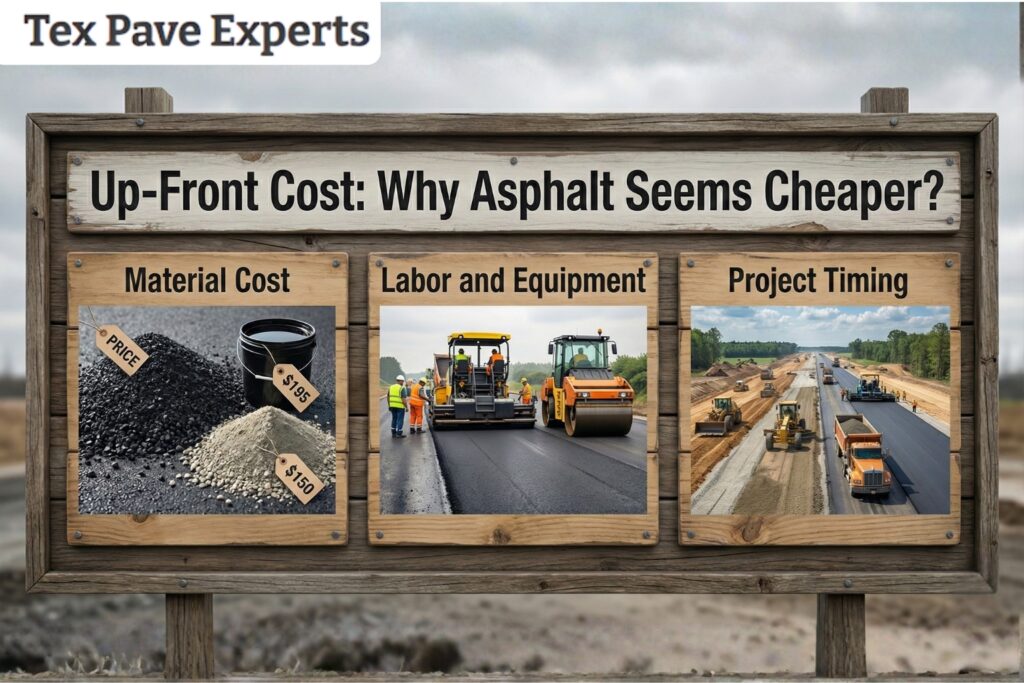
Asphalt driveways and parking lots generally cost less per square foot than concrete. Recent cost surveys show that installing an asphalt driveway typically runs US$7-15 per square foot, whereas concrete driveways cost about US$8-20 per square foot. The lower price of asphalt arises from several factors:
- Material cost: Hot‑mix asphalt is composed of aggregates and bitumen. Bitumen is a by‑product of refining crude oil and is comparatively inexpensive. Concrete uses Portland cement, coarse and fine aggregates, and often steel reinforcement; cement is energy‑intensive and expensive to produce, which drives up concrete’s cost.
- Labor and equipment: Asphalt requires fewer labor hours and can be installed quickly with paving machines. Concrete work is more labor‑intensive (forming, reinforcing, and finishing) and has a longer curing period. For a typical driveway, labor adds roughly US$5-7 per square foot for asphalt versus US$2-10 per square foot for concrete, further widening the price gap.
- Project timing: Asphalt cures quickly, usually within 24-48 hours allowing traffic and loads sooner. Concrete can require up to a week before heavy vehicles are permitted, which adds to downtime and potential revenue loss for commercial sites.
Because of these factors, a 500-600‑sq‑ft asphalt driveway often costs US$4 000-12 000, whereas a similar concrete driveway might be US$5 000-15 000.
For a detailed breakdown of the variables that influence paving prices, such as asphalt thickness, recycled content, and job size, see our cost guide.
Longevity and Maintenance: Looking Beyond the Sticker Price
Initial cost isn’t the only factor. Concrete pavements generally last longer, with typical service lives of 30-40 years. Asphalt surfaces last 15-30 years. The difference lies in each material’s structure:
- Concrete’s rigid structure is highly resistant to deformation and rutting; properly designed concrete pavements distribute loads through a rigid slab, reducing stress on the subgrade. Because cement hydrates and bonds aggregates chemically, the surface is more durable and requires less frequent maintenance.
- Asphalt’s flexible nature means it can expand and contract with temperature changes, reducing the risk of cracking in cold climates. However, its binder (bitumen) oxidizes under UV radiation and heat. Sealcoating every 2-3 years keeps asphalt waterproof and slows oxidation, but sealcoating costs roughly US$0.15-0.30 per sq ft and adds to long‑term expenses. Asphalt surfaces may also need resurfacing or patching every 10-15 years, whereas concrete requires fewer interventions.
- Repair difficulty: Small cracks in asphalt are easy to fill or reseal; large areas can be resurfaced without replacing the base. Concrete repairs are more laborious, cutting and re‑pouring sections, which increases repair costs.
Long‑term maintenance impacts overall spending. A 30‑year cost analysis of a two‑car driveway estimated that asphalt’s total cost (initial installation plus maintenance) was about US$14,500, while concrete totaled around US$18,200. Asphalt still appears cheaper, but the gap narrows when sealcoating and resurfacing are included.
If you plan to use your surface heavily or need it to last decades with minimal upkeep, explore the pros and cons of each pavement method in our guide to asphalt resurfacing vs replacement.
Climate and Performance Considerations
Choice of material isn’t just about cost climate matters. Asphalt performs well in colder regions because it retains flexibility. It can better withstand freeze‑thaw cycles without cracking, which is why many northern highways use asphalt. Concrete’s rigidity helps it stay stable in hot climates where asphalt might soften and rut. Experts note that asphalt driveways are more forgiving in cold weather but can deform under extreme heat, whereas concrete stays cool and resists deformation.
Texas’s weather alternates between hot summers and occasional cold snaps. To maximize durability, contractors often recommend scheduling asphalt work in spring or early fall when daytime temperatures stay between 50 °F and 90 °F (10-32 °C). For more seasonal insights, read our article on the best time to repave your driveway.
Is Asphalt Cheaper Than Concrete?: Considering Life‑Cycle Costs
While asphalt is typically 30-40 % cheaper to install, concrete has a lower life‑cycle cost by about 20-25% because it requires fewer repairs and lasts longer. In other words, you might pay more up front for a concrete driveway, but you’ll likely spend less over the decades on maintenance.
Another factor is resale value and aesthetics. Concrete offers more design options, such as stamped patterns and colored finishes, and its lighter color reflects heat, reducing the urban heat‑island effect. Asphalt’s uniform black surface warms quickly in winter (a safety advantage when melting snow) but absorbs more heat in summer. When choosing between materials, consider how the surface will complement your property and whether appearance matters.
When Asphalt Makes Sense?
Asphalt is often the better choice if:
- You have a limited budget or a large area – Parking lots, long rural driveways, or municipal roads are more affordable to pave with asphalt. The Federal Highway Administration notes that asphalt’s initial price is often 30-40% less than concrete, largely due to faster construction and cheaper materials.
- You need quick installation and minimal downtime – Asphalt surfaces can support traffic within a few days, minimizing disruptions for businesses or busy households.
- Your property is in a colder climate or experiences freeze‑thaw cycles – Asphalt’s flexibility helps it endure thermal expansion and contraction without significant cracking.
- You anticipate repairs or changes – Because asphalt can be resurfaced cost‑effectively, it’s ideal for evolving properties. See our tips for dealing with asphalt driveway cracks if you’re already facing surface issues.
When Concrete Is Worth the Investment?
Concrete may be the better investment if:
- You want maximum longevity with minimal maintenance – Concrete pavements can last 30-40 years with periodic joint sealing and occasional patching. If you prefer a “set it and forget it” surface, the extra cost is justified.
- You expect heavy loads or high traffic – Concrete’s compressive strength suits industrial sites, RV parking or areas used by large trucks. Its rigidity resists rutting and deformation.
- You value aesthetics or customization – Concrete can be stamped, stained or textured. In residential settings, decorative concrete may boost curb appeal and resale value.
- Heat or sunlight are concerns – Light‑colored concrete reflects sunlight, keeping surfaces cooler. For patios or pool decks where comfort underfoot matters, concrete is often preferable.
If you’re leaning toward concrete, review our concrete pavement maintenance tips to ensure a long service life.
The Science of Materials: Why Costs Differ?
Understanding how each material is made clarifies why prices vary. Asphalt is a composite of stone aggregates coated with bitumen. The cost is tied to petroleum prices and the availability of recycled asphalt pavement (RAP). Using RAP can lower costs by 20-30 % and reduce waste. Concrete, meanwhile, relies on Portland cement, a highly energy‑intensive material, combined with aggregates and water. Cement prices fluctuate with energy markets and supply chain factors.
Installation methods also affect cost. Asphalt is laid and compacted in layers using pavers and rollers; thickness, type of mix (hot, warm, or cold), and compaction quality influence durability. Concrete requires forms, reinforcement, proper curing, and joint spacing. Poor workmanship in either material can lead to premature failure learn to spot signs of a bad asphalt job to protect your investment.
For an overview of modern paving methods, including hot‑mix, warm‑mix, and recycled techniques, check our asphalt paving techniques guide
Making Your Decision
So, is asphalt cheaper than concrete? Yes, asphalt generally has a lower initial cost due to cheaper materials and faster installation. However, concrete often provides better long‑term value because of its longevity and lower maintenance needs. The right choice depends on your budget, climate, expected traffic, aesthetic preferences, and willingness to perform ongoing maintenance.
If you’re still uncertain, consider scheduling a consultation. At Tex Pave Experts, we guide clients through all phases of paving, from material selection to maintenance, and offer both asphalt and concrete services. Our team has decades of experience in North Texas and can recommend the best solution for your property. Learn more about our asphalt paving services or find out our full range of concrete services to find the surface that fits your needs and budget.
Locations We Service
What Is Asphalt Made Of? Understanding Its Core Materials
As paving specialists with decades of experience, we often hear property owners ask, “What exactly is asphalt?” If you’ve ever walked on a blacktop driveway or parked your car on a smooth roadway, you’ve already experienced this versatile construction material. Asphalt is a composite pavement mixture made from a petroleum‑derived binder called bitumen, a blend of aggregates (sand, gravel and crushed stone), and a small proportion of mineral fillers to fine‑tune the mix. Each ingredient serves a scientific purpose: the sticky binder coats every stone to hold the mix together and waterproof it, while the interlocking aggregate particles provide strength and load‑bearing capacity. The mineral fillers fill microscopic voids, improving density and helping the pavement resist cracking. Understanding this recipe helps you appreciate why does asphalt lasts so long and why an expert contractor makes such a difference.
What Are the Main Components of Asphalt?
1. Bitumen (Binder)
- What it is: Bitumen is a viscous, tar‑like material refined from crude oil. It exists in natural deposits and is also produced in petroleum refineries. In road building, bitumen is used as asphalt cement or emulsion. It makes up about 5-6% of a hot mix asphalt by mass.
- Why it’s used: Because of its sticky molecular structure, bitumen adheres to aggregates and creates a continuous film. It keeps the pavement waterproof and protects the underlying base from moisture damage. Modifiers such as polymers, fibers, or waxes can be added to improve adhesion, reduce flow, and enhance temperature resistance.
- How it affects performance: Bitumen’s viscosity changes with temperature. Engineers select specific grades of bitumen so the pavement remains flexible in cold weather yet resists rutting in hot weather. Proper binder content helps asphalt resist cracking and provides the right balance between stiffness and flexibility.
2. Aggregates (Stone, Sand, Gravel)
Aggregates are the backbone of asphalt. Coarse and fine aggregates make up roughly 95% of the mixture by mass. In practice, mixtures blend different sizes of crushed rock, sand, gravel, or slag to achieve an optimal gradation. Interlocking particles distribute vehicle loads evenly, providing stability and load‑bearing capacity. Well‑graded aggregates with angular shapes improve friction and reduce the risk of raveling. Their durability, shape, and resistance to moisture are crucial to long‑term pavement performance.
3. Mineral Fillers
Mineral fillers are extremely fine particles (often limestone dust or hydrated lime) added to fill tiny voids between aggregates. They typically make up less than 3% of a hot mix asphalt by mass. Fillers improve density, increase stiffness, and help the binder form a cohesive mastic. By reducing air voids, they allow better compaction, which translates to a longer‑lasting pavement.
How Asphalt Is Produced (Simple Process Overview)
Modern asphalt is made in purpose‑built mixing plants. Whether stationary or mobile, these facilities can produce up to 800 tons of hot mix per hour and heat the materials to temperatures between 150 °C and 180 °C. Here’s a simplified overview of the process:
- Heat the aggregates: Crushed stones and sand are dried and heated in a rotating drum to remove moisture.
- Heat and liquefy the bitumen: Bitumen is stored in insulated tanks and warmed until it flows like thick syrup.
- Mix at controlled temperature: The hot aggregates and liquid binder are blended together in the mixing drum along with mineral filler. Adhering to temperature specifications ensures the binder coats each particle without burning.
- Quality testing: Samples are tested to verify gradation, binder content, and air voids. Adjustments are made to meet job specifications.
- Transport and pave: The finished mix is loaded into insulated trucks and transported to the job site. Paving machines lay the mix, and rollers compact it while it’s still hot.
This step‑by‑step process is carefully controlled to deliver consistent quality. Advances like computer‑controlled plants and automated proportioning have improved consistency and reduced waste.
Types of Asphalt (Based on Modern Use Cases)
Different paving situations call for different mix designs. Asphalt mixtures can be produced at various temperatures, and with different objectives in mind:
- Hot Mix Asphalt (HMA) – The most common asphalt used for roads and parking lots. It is produced at 150-180 °C. The high temperature ensures complete coating of aggregates and provides high durability. It is ideal for heavy‑traffic highways and structural layers because the mix gains strength quickly.
- Warm Mix Asphalt (WMA) – WMA is produced 20-40 °C lower than HMA. Lower production temperatures reduce energy consumption and emissions, resulting in up to 75% fewer fumes. It also improves working conditions for paving crews and allows compaction at cooler temperatures, enabling extended paving seasons and earlier opening of roads.
- Cold Mix Asphalt – Cold mixes use bitumen emulsified in water, so aggregates don’t need heating. During mixing and compaction, the emulsion breaks and water evaporates, creating a durable coating. Cold mixes are ideal for lightly trafficked roads or temporary repairs because they are inexpensive and can be produced without a plant.
- Porous (Permeable) Asphalt – Porous asphalt uses open‑graded aggregates and a stone reservoir underneath to allow rainwater to infiltrate through the pavement. This low‑impact development technology helps manage stormwater by reducing runoff and filtering pollutants. It is recognized as a best practice by the U.S. EPA and many state agencies and is increasingly used for parking lots, trails, and driveways where groundwater recharge is beneficial.
Asphalt vs Bitumen: What’s the Difference?
These terms are often used interchangeably, but they refer to different things. Bitumen is the black, sticky, highly viscous liquid or semi‑solid petroleum product used as the glue in road construction. It may occur naturally or be refined from crude oil. Asphalt, on the other hand, is the engineered mixture of aggregates, bitumen, and filler used to pave roads, parking areas, and even bicycle lanes. Think of bitumen as the cement in concrete; it binds the rock particles to create a strong composite material. Because asphalt includes stone and sand, it has structural strength that bitumen alone lacks. When people refer to “asphalt pavement,” they mean the mixture, whereas “bitumen” refers solely to the binder.
How Long Does Asphalt Last & What Affects Durability?
Designers typically engineer asphalt pavements to perform for around 20 years. With regular maintenance-crack sealing, surface treatments, milling, and thin overlays, pavements often last longer. Several factors influence longevity:
- Climate: Extreme moisture and temperature swings weaken asphalt. Freeze-thaw cycles and prolonged exposure to moisture can reduce the strength and durability. Warm mix asphalt can mitigate some thermal stresses by reducing temperature differentials.
- Traffic load: Heavy trucks and high traffic volumes accelerate wear. Pavements on interstates or industrial sites require thicker sections and higher‑grade binders to withstand stress.
- Base preparation: A stable, well‑compacted foundation supports the asphalt layer. Poor drainage or weak subgrade soils lead to premature cracking and potholes.
- Mix design and construction quality: Proper gradation, binder content, compaction, and thickness ensure the pavement can distribute loads evenly and resist rutting. Experienced contractors like us tailor each mix to the project’s climate and traffic needs.
- Timely maintenance: Sealing cracks, maintaining proper drainage, and addressing minor distress early can retard environmental effects and extend pavement life.
In practice, residential driveways may last 20-30 years, while heavily trafficked highways may need resurfacing after 10-15 years. Investing in quality materials and preventive maintenance pays dividends over the pavement’s life cycle.
Why Choose Texpave Experts?
As a North Texas-based asphalt contractor with over 35 years of experience, we understand that homeowners and property managers aren’t just buying a material; they’re buying peace of mind. Here’s how our expertise aligns with your needs:
- Comprehensive solutions: From driveways to commercial parking lots, we handle everything from site preparation and mix design to paving and striping. Our crews are trained to deliver smooth, durable surfaces that meet local specifications.
- Local expertise: North Texas soils, weather patterns, and traffic conditions require tailored solutions. We know how to select the right mix, binder grade, and thickness to stand up to our region’s hot summers, flash floods, and occasional freezes.
- Versatility: Whether you need a residential overlay, a new subdivision road, or a porous asphalt parking lot for stormwater management, our team can scale to projects big and small.
- Commitment to quality and longevity: We use high‑quality aggregates and binders, follow best practices for compaction and finishing, and recommend maintenance schedules to maximize your pavement’s lifespan. Our track record shows that investing in craftsmanship saves money down the road.
If you’re searching online for the Best Asphalt Contractor Near Texas, give us a call at 972-569-7946 or request a quote. We’d love to discuss your project and design a pavement solution that fits your needs and budget.
Locations We Service
How Much Does Asphalt Paving Cost?
In 2025, asphalt paving costs generally range from about $3-$8 per square foot for residential driveways and $2.50-$7 per square foot for large parking lots or road projects. A typical 500-600 sq ft driveway costs around $4,000-$12,000, while commercial parking lots run $25,000-$150,000 depending on size and features. This guide breaks down costs by project type, explains the factors that influence pricing, compares asphalt to concrete, and shares expert advice to help you budget smarter.
Average Asphalt Paving Costs (By Project Type)
| Project Type | Average Cost | Price Range |
|---|---|---|
| Driveway (500-600 sq ft) | $8,000 | $4,000-$12,000 ($3-$8 per sq ft) |
| Parking Lot (10,000 sq ft) | $35,000 | $25,000-$150,000 depending on size and material; asphalt lots cost $2.5-$4.5 per sq ft, while concrete can be $4-$7 per sq ft |
| Road/Commercial | $80,000+ | Custom quotes; large-scale paving falls around $3-$7 per sq ft, depending on thickness, traffic loads, and site preparation |
Ranges reflect 2025 data and assume 3-5 inch asphalt depth and basic site prep; costs vary by region, labor rates and material grade.
Key Factors That Affect Asphalt Paving Costs
When budgeting for an asphalt project, several variables determine the final price. Understanding these factors helps you make informed decisions.
1. Material Type (Hot Mix vs. Recycled Asphalt)
- Hot‑mix asphalt – The industry standard for driveways and roads. It costs roughly $40-$80 per ton, and about $3-$7 per square foot installed. Hot mix provides a dense, durable surface but relies on virgin bitumen.
- Recycled asphalt (RAP) – Made by milling and reprocessing existing pavement. RAP reduces material costs to $10-$20 per ton and can cut overall project costs by 20-30%. According to the U.S. Federal Highway Administration, recycling asphalt offers engineering and economic benefits and reduces landfill waste. Choosing recycled asphalt is both budget‑friendly and eco‑conscious.
- Sustainability note – The National Asphalt Pavement Association notes that asphalt is America’s most recycled material and that perpetual pavements never need full removal. Clients seeking “eco‑friendly paving” often select RAP or warm‑mix technologies.
2. Thickness and Layering
- Residential driveways usually need a 2-4 inch base layer and a 1.5-2 inch surface layer; full‑depth designs of 4-6 inches increase load capacity. Thicker pavement means more material and labor, raising costs but extending lifespan.
- Commercial lots and roads often require 4-6 inches or more, sometimes with additional binder layers for heavy trucks. Each extra inch adds roughly $0.50-$1 per sq ft in material.
- Ask your contractor about full‑depth vs. base‑and‑surface layering to balance cost and durability.
3. Size and Accessibility of the Area
- Square footage is the biggest cost driver. Larger areas allow contractors to spread mobilization costs across more footage, lowering the per‑square‑foot price. For example, a 10,000 sq ft parking lot costs $25,000-$45,000, while a 500 sq ft driveway may cost $4,000-$8,000.
- Site layout and accessibility matter. Irregular shapes, multiple entrances, and difficult access add labor and may require hand‑finishing or extra equipment. Extra excavation and grading for poor soil or drainage issues also increase costs.
4. Local Labor and Climate Factors
- Labor costs vary by region. National averages range from $40-$55 per hour or $2-$6 per square foot. High‑demand urban areas or remote sites may see higher rates.Climate influences installation timing and maintenance. In North Texas, paving season runs from spring through early fall. Contractors recommend scheduling projects when daytime temperatures consistently stay above 50-60°F; ideal conditions are 70-80°F. Extreme summer heat (>95°F) can soften fresh asphalt, while cold winters hinder compaction.
- Site layout and accessibility matter. Irregular shapes, multiple entrances, and difficult access add labor and may require hand‑finishing or extra equipment. Extra excavation and grading for poor soil or drainage issues also increase costs.
5. Sealcoating and Maintenance Needs
- Curing and early care – After installation, keep vehicles off for at least 3-5 days and wait up to 14 days before parking. Fresh asphalt cures over 6-12 months, so avoid repeated parking in the same spot.
- Protect against spills – Oil, gasoline, antifreeze and other fluids dissolve asphalt; promptly clean leaks and avoid parking leaky vehicles.
- Sealcoating – Seal your driveway about 90 days after paving to protect against UV damage, oxidation and chemicals. Regular sealcoating every 2-3 years costs about $0.15-$0.30 per sq ft, and prolongs pavement life.
- Resurfacing – Heavy‑use lots require resurfacing every 15-20 years. The cost ranges from $2-$7 per square foot.
Asphalt vs. Concrete: Which is More Cost‑Effective?
When choosing a paving material, weigh upfront costs against durability and maintenance.
| Aspect | Asphalt Driveway | Concrete Driveway |
|---|---|---|
| Installed cost (per sq ft) | $5-$12 | $6-$15 |
| Typical total cost (2-car) | $2,000-$7,200 | $2,400-$8,600 |
| Durability & lifespan | 15-30 years; flexible surface resists cracking in cold climates | 30-40 years; rigid slab lasts longer but can crack under shifting soils |
| Maintenance | Requires periodic sealcoating and repairs; easier and cheaper to fix | Less maintenance overall; repairs are more expensive and require longer curing |
| Appearance | Typically black; limited customization | Highly customizable with colors, patterns, and finishes |
| Climate suitability | Ideal for cold climates due to flexibility; warms quickly in winter | Better for warm climates; stays cooler in summer |
Takeaway: Asphalt offers a lower upfront cost and quicker installation, making it popular for driveways and parking lots. Concrete lasts longer and requires less frequent upkeep but costs more initially. For North Texas homeowners who want a fast, cost‑effective solution, asphalt is usually the better value.
Cost-Saving Tips from Paving Experts
Drawing on 35 years in the asphalt industry, our team at Tex Pave Experts shares these money‑saving strategies:
- Get multiple quotes: Pricing varies by contractor and local labor rates. Comparing at least three quotes ensures you pay a fair rate and helps uncover differences in materials and warranties.
- Schedule in the off‑season: In North Texas, early spring or late fall often offers better pricing because contractors are less busy and material prices may be lower. Avoid peak summer heat, which can affect curing and increase labor costs.
- Choose recycled or warm‑mix asphalt: These sustainable options reduce material costs and environmental impact. Ask your contractor if recycled asphalt pavement (RAP) is appropriate for your project.
- Optimize thickness: A thicker pavement lasts longer but costs more. For residential driveways, a 4‑inch full‑depth section typically provides a good balance; heavier vehicles may warrant 5-6 inches. Ensure your quote specifies thickness so you can compare apples to apples.
- Maintenance plan: Budget for sealcoating every few years and prompt crack repairs. Preventive maintenance costs less than major repairs.
- Work with a local expert: Looking for best asphalt contractor near texas? A contractor familiar with North Texas soils and climate will design pavements that resist heaving and rutting. As a seasoned local company, Tex-pave experts provides comprehensive asphalt and paving solutions, from driveways to commercial lots, backed by a commitment to quality and longevity. Most asphalt driveways cost between $3 and $20 per square foot. We start at $1.75 a sq ft, depending on size/volume. To contact you can request a quote or contact through number – 972-569-7946
Frequently Asked Questions
1. How long does asphalt paving last?
Well‑constructed asphalt driveways typically last 15-30 years, with regular sealcoating and maintenance. Commercial lots may need resurfacing every 15-20 years, while low‑traffic residential surfaces can exceed 20 years. Climate, traffic loads and maintenance practices all influence lifespan.
2. What time of year is best for paving?
Paving performs best when temperatures are 50-80°F and dry. Spring (late April-May) and fall (September-October) offer the most stable weather. Summer can work if temperatures aren’t extreme, but schedule early morning installs to avoid heat. Winter paving is generally discouraged because cold ground prevents proper compaction.
3. Does asphalt paving increase home value?
Yes. A fresh, well‑designed driveway boosts curb appeal and can make your property more attractive to buyers. While there’s no exact ROI, many real‑estate agents consider a new driveway a high‑impact upgrade. Concrete may add slightly more value due to its longer lifespan, but asphalt’s lower cost and quick installation often provide a better return.
4. How do I maintain a new asphalt driveway?
- Curing period: Keep vehicles off for 3-5 days and avoid parking in the same spot for the first few weeks. Fresh asphalt remains pliable for 6-12 months.
- Prevent damage: Avoid sharp turns and don’t turn your steering wheel while stationary. Clean up oil, fuel, or antifreeze spills immediately.
- Sealcoat regularly: Apply a sealcoat ~90 days after installation and every 2-3 years thereafter to protect against UV rays and chemicals. Sealcoating costs roughly $0.15-$0.30 per sq ft, and greatly extends pavement life.
- Control weeds and support edges: Trim vegetation and backfill edges to prevent cracking. Avoid parking heavy equipment near the edges.
Best Time to Repave Your Driveway
When is the best time to repave a driveway? This guide uses science and decades of paving experience to explain seasonal tips, ideal temperature ranges, and advice from a North‑Texas-based asphalt specialist.
What Is Driveway Repaving and Why Timing Matters?
Repaving means replacing the surface layer of an existing driveway with fresh hot‑mix asphalt. It differs from resurfacing, which simply places a thin overlay on top of the existing pavement. When the underlying base has deteriorated or large cracks develop, repaving provides a fresh structural layer. Getting the timing right matters because asphalt is an engineered material: it must be hot enough to flow and compact but cool slowly to gain strength. During construction, asphalt is generally placed at 280 – 300 °F (about 140 – 150 °C), then compacted as it cools. The binder (bitumen) softens at about 140 °F/60 °C, so cooler temperatures increase viscosity and allow the material to hold its shape. Too little heat during placement leads to poor compaction, while extreme heat can cause the binder to remain too soft.
Scientific link – asphalt chemistry & ambient temperature
Asphalt consists of aggregates coated with bitumen. Viscosity of the binder varies with temperature; soft binders have lower viscosity at 140 °F/60 °C, while hard binders remain viscous. During installation, the mix must stay within a temperature window so it is workable yet able to cool and solidify. If the ambient temperature is too low, the surface cools too quickly and compaction fails; if it is too high, the pavement may remain soft and deform under traffic. That’s why experienced contractors watch the weather before planning their project.
The Best Time of Year to Repave Your Driveway
Short answer: The best time to repave your driveway is during spring or early fall when daytime temperatures are between 50 °F and 90 °F (10 °C to 32 °C). Warm but not scorching weather allows optimal compaction and curing.
When asphalt is placed, the surface and air temperature must meet minimum thresholds. Municipal specifications often prohibit placing asphalt when air or ground temperatures are below 40 °F (4 °C) and require the temperature to exceed 50 °F (10 °C) for thin surface courses. The Texas Department of Transportation notes that seal coats and surface treatments should be applied only when the air temperature is above 50 °F and rising and may not be applied if the surface is below 60 °F. Cooler weather prevents proper bonding; extremely hot summer days, on the other hand, can cause the binder to remain soft, leading to rutting or tire marks. Spring and early fall provide moderate temperatures and reduced rainfall, making them ideal windows.
Seasonal breakdown
| Season | Pros | Cons |
|---|---|---|
| Spring | Stable temperatures, moderate humidity; early-season repaving allows the surface to cure before summer heat. | Occasional rain can delay work and cause surface moisture. |
| Summer | Fast drying and high heat improve compaction; long daylight hours allow more working time. | Excessive heat can soften fresh asphalt, leading to scuffing and tire marks. |
| Fall | Consistent curing conditions; cooler evenings reduce risk of rutting. | Early frost or cold snaps in northern regions can shorten the window for proper compaction. |
| Winter | Not recommended | Air/ground temperatures often below 40°F; asphalt won’t bond properly. |
Why we choose these windows?
In North Texas, temperatures can swing from freezing in winter to over 100 °F in summer. Repaving in spring (March-May) or early fall (September-November) avoids extreme heat and cold, ensuring the mix remains workable but cools slowly enough to gain strength. As a local contractor, we monitor local weather patterns and schedule your project during dry, mild weeks to maximize performance.
Signs It’s Time to Repave (vs. Repair or Resurface)
Not every driveway needs repaving. Sometimes crack sealing or a thin overlay will suffice. You should consider repaving when:
- Cracks wider than ¼ inch: Preventive maintenance guides from state departments of transportation recommend sealing cracks wider than ¼ inch. If cracks have grown larger or multiply across the surface, the pavement structure may be failing, and repaving offers a longer‑term solution.
- Pooling water or poor drainage: Standing water damages asphalt by stripping the binder from aggregates, weakening the pavement and causing crumbling. If your driveway stays wet after rain or has depressions, repaving can re‑establish proper slope and drainage.
- Fading, unraveling or rough texture: UV exposure oxidizes the binder; once the surface turns from black to gray and aggregate comes loose, repaving may be more cost‑effective than constant patching.
- Multiple previous repairs: If numerous potholes and patches exist, adding more repairs may be expensive. Repaving restores a uniform surface and improves curb appeal.
A professional inspection can determine whether localized repairs or resurfacing are sufficient or whether the base has deteriorated enough to justify repaving.
How Weather & Temperature Affect Asphalt Performance
- Curing chemistry: Asphalt is placed hot (around 280 – 300 °F) and cools to form a solid matrix. The binder’s viscosity at 140 °F/60 °C dictates how well it coats aggregates. Cooling too quickly (cold weather) prevents proper bonding and may leave voids; overly hot weather can make the pavement too soft.
- Thermal expansion and contraction: As temperatures change, asphalt expands and contracts. Repeated freeze‑thaw cycles can widen small cracks, leading to potholes. In North Texas, freeze‑thaw cycles are less severe than in northern climates but still occur during occasional cold snaps.
- Moisture infiltration: Water is one of asphalt’s biggest enemies. According to the U.S. Forest Service, standing water strips asphalt binder from aggregates and weakens the pavement. Proper drainage through a crowned or sloped surface (1-2 % grade) reduces moisture penetration and prolongs pavement life.
Why Choose Us?
As a property owner in North Texas, you want a driveway that’s safe, attractive and built to last. Best Asphalt Contractor Near Me isn’t just a marketing phrase it’s a promise backed by more than 35 years of hands‑on experience and a deep understanding of local conditions. Our unique selling points include:
- Comprehensive asphalt & paving solutions: From driveways and parking lots to sealcoating and drainage improvements, we handle every aspect of your project.
- Local expertise across North Texas: We’re familiar with the region’s soils, weather patterns and regulations, ensuring that your driveway is designed for long‑term performance.
- Versatility in project scope: Whether you need a residential driveway, a commercial lot or roadway repairs, our team is equipped to handle projects of any size.
- Commitment to quality & longevity: We use premium materials, proven techniques and strict quality control. Proper compaction, tack coating and drainage details extend pavement life and reduce your maintenance costs.
Frequently Asked Questions
1. Can I repave my driveway in winter?
Repaving in winter is generally not recommended. Specifications prohibit placing asphalt when air or ground temperatures are below 40 °F. Cold weather prevents proper compaction and bonding, leading to premature cracking. If an emergency repair is required, cold‑patch materials can be used, but full repaving should wait until spring or fall.
2. How long does new asphalt take to cure?
New asphalt cools and becomes traffic‑ready within a day, but full curing (oxidation and hardening) takes several months. Most contractors advise waiting about 6-12 months before expecting the pavement to reach its maximum hardness. During this period, avoid heavy loads, chemical spills and sharp objects. Sealcoating should be applied after the pavement has oxidized slightly, usually 30-90 days after installation.
3. Should I sealcoat after repaving?
Yes. Sealcoating adds a protective layer that reduces oxidation, repels water and enhances appearance. For newly repaved driveways, apply a sealcoat after the surface has cured sufficiently (30-90 days) and then reapply every 3-5 years or as recommended.
4. How long does repaving last?
With proper installation and maintenance, a residential asphalt driveway can last 15-20 years. The Federal Highway Administration notes that agencies expect asphalt pavements to last at least 20 years, and preservation treatments can extend life by several years. Regular crack sealing and timely sealcoating help you reach the upper end of this range.
Asphalt Paving Techniques: Modern Methods for Durable and Sustainable Roads
As a family‑run asphalt contractor with more than 35 years of experience in North Texas, we know pavement is more than just putting down a new surface. It’s about creating a safe, durable road that suits your budget and the way you use it. In this guide we demystify common asphalt paving techniques, hot mix, warm mix, cold mix and recycled pavement, and explain the factors that make them succeed. You’ll also learn how our local expertise and commitment to quality help you select the best option and avoid common pitfalls.
What is Asphalt Paving? (Definition + Core Concept)
Asphalt pavement is made from aggregates (crushed stone, gravel, sand, or recycled materials) bound together by a bituminous binder. The European Asphalt Pavement Association notes that aggregates provide most of the load‑bearing strength, while bitumen acts as the glue that holds the mixture together. Asphalt mixtures are typically produced in an asphalt plant; hot mix asphalt (HMA) is manufactured at around 150-180° C, and Most mixes contain 90‑95% aggregates and about 4‑8% binder by weight. Once mixed, the hot material is placed and compacted on the road surface, where it cools and hardens to form a durable pavement.
Common Asphalt Paving Techniques (with Practical Applications)
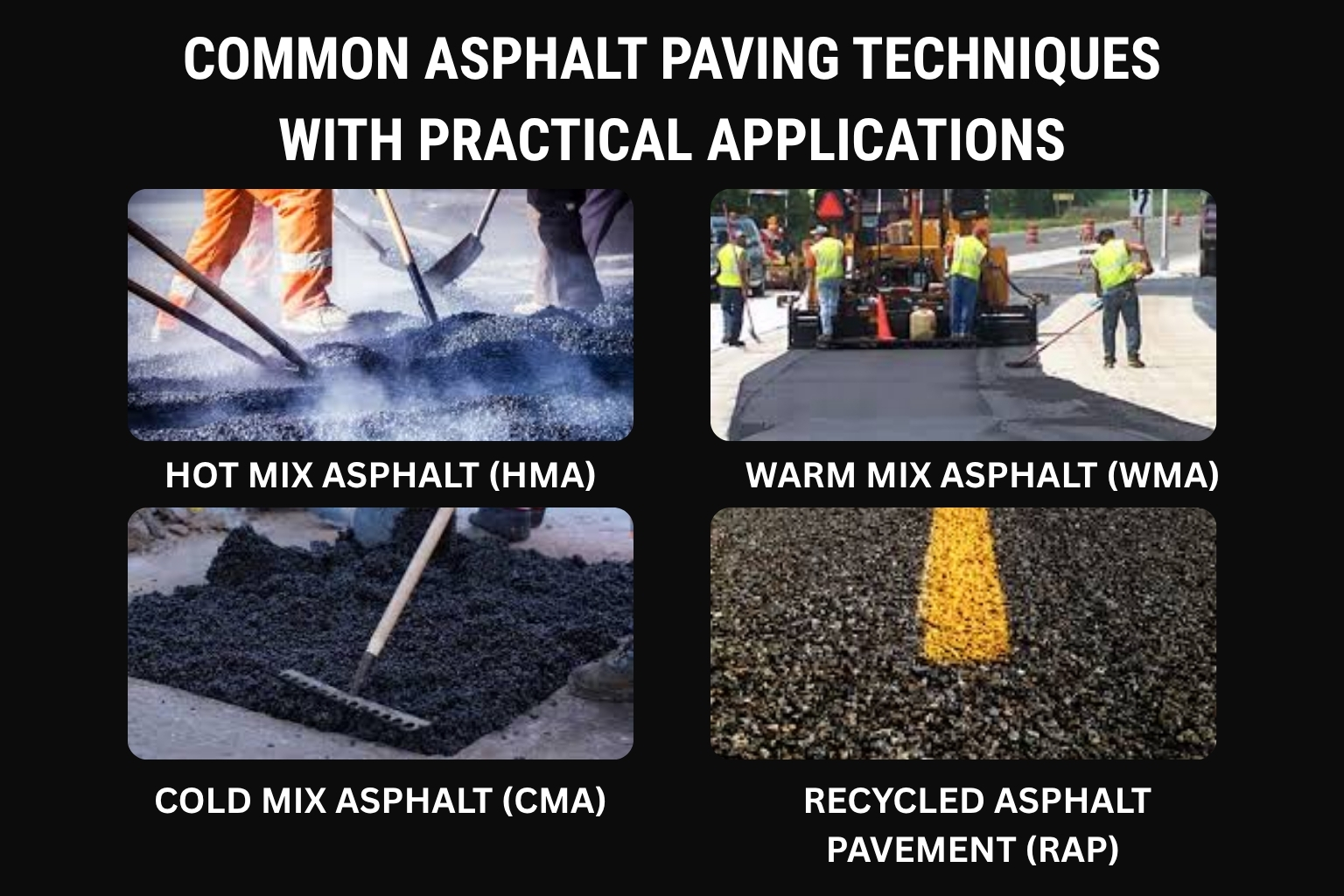
1. Hot Mix Asphalt (HMA)
Hot mix asphalt is the traditional standard for building roads and parking lots. In the HMA process, aggregates and asphalt cement are heated above 300°F and thoroughly mixed. The high temperature makes the binder fluid so it coats the aggregates and remains workable during transport and placement. HMA is ideal for heavy‑traffic highways and airport runways because it provides excellent structural strength and can be optimized for specific climate and loading conditions. However, the high temperatures require more energy, emit more fumes and limit paving to warmer seasons. Quality control, especially temperature management during transport and compaction is critical; if the mix cools too quickly it can be difficult to achieve the density needed for long‑term performance.
2. Warm Mix Asphalt (WMA)
Warm mix asphalt uses additives or foaming processes to lower mixing and placement temperatures by 30-120° F compared with HMA. According to the Federal Highway Administration (FHWA), WMA can reduce fuel consumption during production by about 20% and extend the paving season because the mixture cools more slowly. The lower temperature also improves compaction (helping achieve higher density), allows longer haul distances and reduces fumes and odors at the job site. For property owners, WMA provides a more environmentally friendly pavement without sacrificing performance. When you read more on the FHWA’s Warm Mix Asphalt page, you’ll find that WMA has been used successfully for a variety of pavement types and traffic levels.
3. Cold Mix Asphalt
Cold mix asphalt is produced without heating the aggregates. The European Asphalt Pavement Association explains that this is possible because bitumen is emulsified in water, which breaks during mixing or compaction to coat the aggregate; strength increases as the water evaporates during curing. Because it doesn’t require high temperatures, cold mix is ideal for lightly trafficked roads, pothole repair and remote locations. It’s easy to produce and apply, but it doesn’t achieve the same strength as hot or warm mixes and often serves as a temporary or low‑volume solution.
4. Recycled Asphalt Pavement (RAP)
Reclaimed asphalt pavement (RAP) is material generated when existing pavements are removed during resurfacing or reconstruction. The National Asphalt Pavement Association notes that RAP consists of high‑quality aggregates coated with durable asphalt binder. By milling and reusing this material in new mixes, contractors reduce the demand for virgin aggregates and binders and significantly lower environmental impact. For example, recycling RAP in 2019 saved an estimated 58.9 million cubic yards of landfill space and reduced greenhouse‑gas emissions. The same report states that using about 21 % RAP in new asphalt mixtures saved U.S. pavement owners roughly $7.80 per ton. When designed correctly, RAP mixtures can perform as well as virgin mixes. For more details on RAP recycling, visit the FHWA’s recycling page, which outlines the agency’s sustainability objectives and best practices for incorporating reclaimed materials.
Factors Influencing Asphalt Pavement Quality
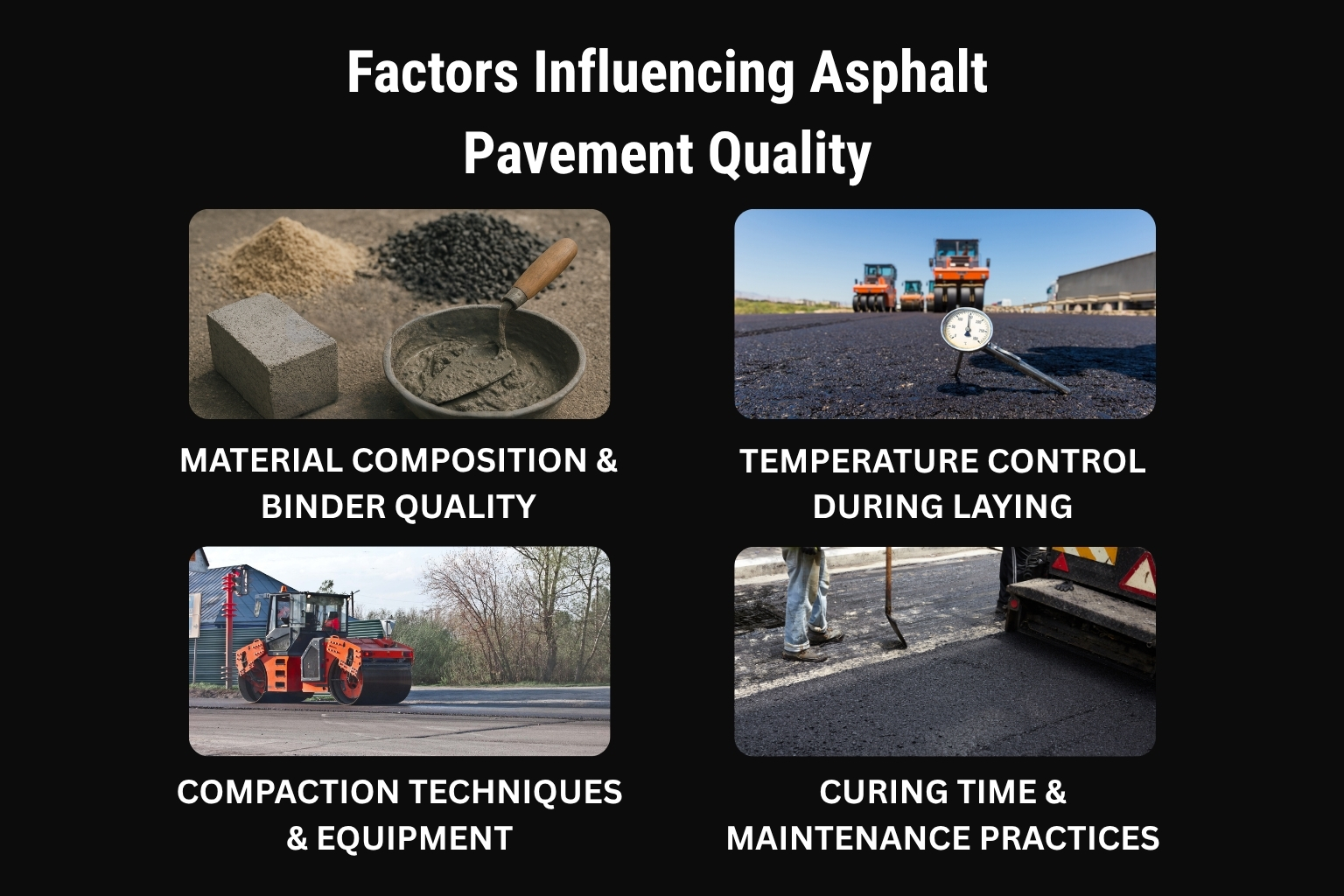
Material Composition & Binder Quality
A durable pavement starts with selecting the right aggregate gradation and binder grade. The Wisconsin Highway Research Program notes that durability depends on binder specifications, aggregate specifications, volumetric properties, moisture sensitivity and in‑place compaction. Laboratory studies found that cracking resistance improves when the mix contains more effective binder, uses a softer binder grade, limits recycled binder content, and incorporates polymer modifiers. In practice this means tailoring the binder to local climate and traffic conditions and verifying mix designs through testing. Our team uses high‑quality binders and may recommend polymer‑modified asphalt for heavy or temperature‑extreme applications.
Temperature Control During Laying
Temperature is central to asphalt quality. WMA lowers the mixing temperature and reduces the risk of premature cooling, but HMA still needs to stay above its compaction temperature until the rollers complete their passes. Excessively high temperatures can damage the binder, while too‑low temperatures make the mix too stiff to achieve density. FHWA guidance on compaction stresses that environmental variables layer thickness, temperature, wind speed, solar flux and time available for compaction must be considered when planning the rolling pattern. Our crews monitor ambient conditions and adjust equipment and rolling sequences accordingly to avoid cold spots and ensure a smooth, dense mat.
Compaction Techniques & Equipment
Proper compaction is one of the most important factors controlling pavement life. FHWA research shows that increasing in‑place density by just 1% can boost fatigue performance by 8-44% and improve rutting resistance by 7-66%. Achieving this density requires the right combination of rollers and passes. The same FHWA brief lists common obstacles stiff or tender mixes, weak base, improper rolling patterns and recommends adjusting roller speeds, vibration settings and patterns to overcome them. We use modern vibratory rollers and continuous density measurement tools to meet or exceed density specifications, ensuring long‑lasting pavements.
Curing Time & Maintenance Practices
Asphalt surfaces continue to gain strength after compaction. The Texas Department of Transportation’s full‑depth reclamation guidelines describe three curing phases: initial curing (about 30 minutes-2 hours) allows the surface to gain enough strength to resist traffic; intermediate curing (a few days to two weeks) allows moisture to escape before surfacing; and final curing (30-60 days) brings the material to full strength. Opening a pavement too soon or allowing water to sit on the surface can compromise durability. After the pavement cures, routine maintenance such as sealing cracks, addressing drainage and scheduling periodic overlays will prolong its service life. Our maintenance programs help clients budget for these treatments and avoid costly repairs down the road.
Sustainable Asphalt Paving Methods (Future‑Ready Practices)
Sustainability is at the heart of modern paving. Warm mix asphalt is an environmentally friendly alternative to traditional hot mix; it lowers production temperatures, reduces fuel use and emissions, and improves working conditions. Reclaimed asphalt pavement (RAP) conserves natural resources and saves money 2019 recycling efforts saved $3.3 billion nationwide and diverted millions of tons of material from landfills. Other innovations include recycled tire rubber as an asphalt binder modifier; the FHWA notes that rubberized asphalt recycles waste tires and can deliver long‑life, cost‑competitive pavements. Researchers are also developing bio‑based binders and incorporating waste materials such as plastics and glass into asphalt mixtures to further reduce carbon footprints. Our commitment to sustainability means we evaluate these options and recommend solutions that balance environmental benefits with performance.
How to Choose the Right Asphalt Technique for Your Project
Selecting the best paving method depends on your project’s traffic load, climate, budget and sustainability goals. Heavily trafficked highways or industrial yards usually require hot mix asphalt because of its structural strength and proven performance. For residential streets, parking lots or projects seeking lower carbon footprints, warm mix asphalt offers similar performance with energy savings and reduced emissions. Cold mix asphalt serves well for low‑volume roads, temporary surfaces and pothole patching, while RAP mixtures are excellent for resurfacing when sustainability and cost savings are priorities.
Because there’s no one‑size‑fits‑all solution, we start every project with a thorough assessment of soil conditions, drainage, anticipated loads and budget. Our local knowledge of North Texas soils and weather patterns informs mix design and pavement structure recommendations. Whether you’re planning a commercial parking lot or a rural driveway, our team can help you determine the best technique to meet your needs. If you’re searching for the Best Asphalt Contractor Near Me, our extensive experience and comprehensive services ensure your project is built to last.
Common Mistakes in Asphalt Paving (and How to Avoid Them)
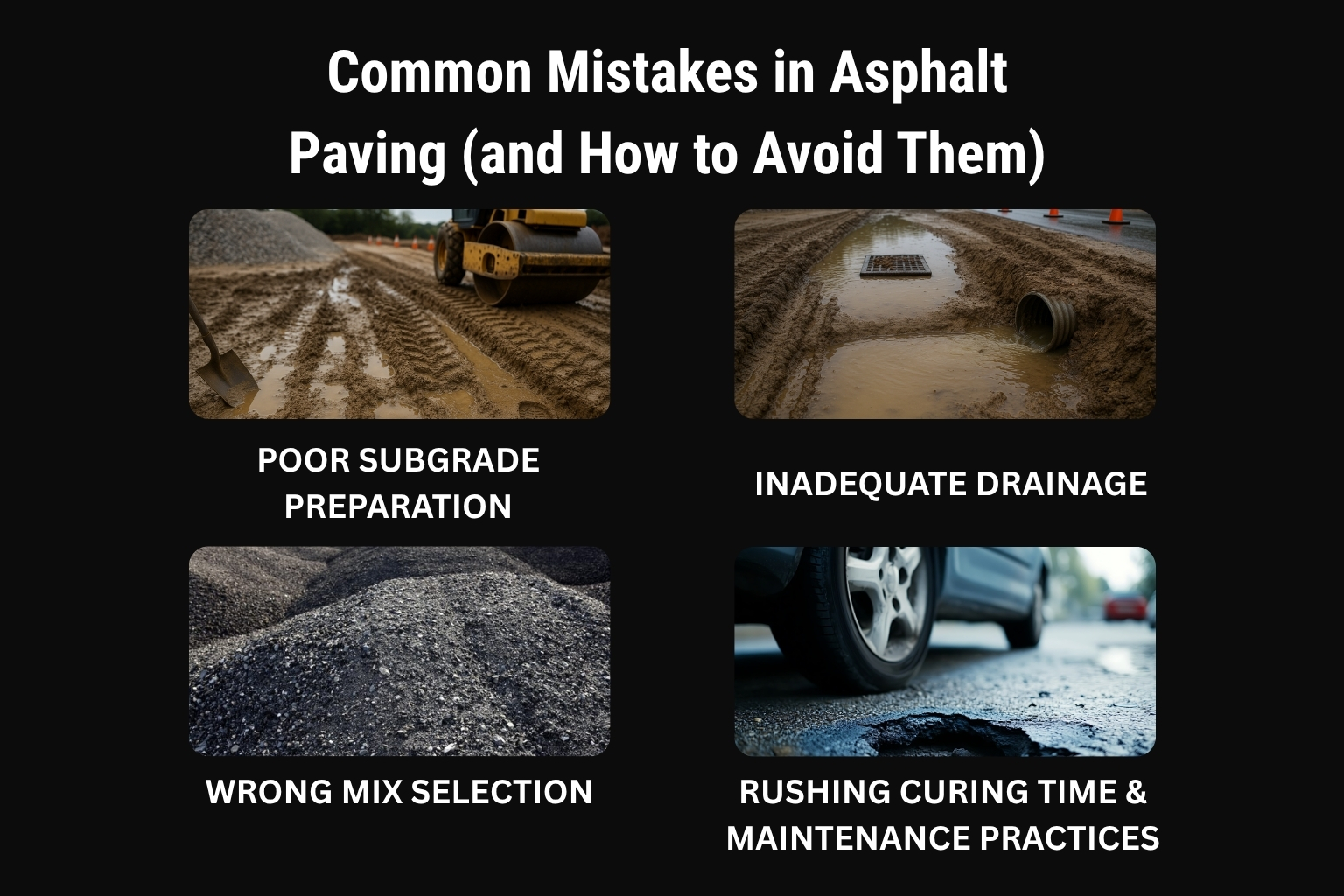
- Poor subgrade preparation – Neglecting to stabilize or compact the base leads to uneven settlement and cracking. We perform site‑specific soil tests and, if necessary, incorporate base stabilization or full‑depth reclamation to create a strong foundation.
- Inadequate drainage – Water is asphalt’s enemy. Improper grading or blocked drains allow water to infiltrate the pavement, causing potholes and rutting. We design proper slopes and drainage structures and recommend sealing cracks promptly.
- Wrong mix selection – Using a mix designed for light traffic on a heavy‑haul road shortens service life. Consult with an experienced contractor to select the correct mix grade and binder for your climate and traffic conditions.
- Insufficient compaction – Failing to achieve target density decreases pavement strength. Following FHWA best practices including monitoring mat temperature and adjusting roller patterns, helps avoid this mistake.
- Rushing curing and maintenance – Opening the pavement to traffic before initial curing or skipping routine maintenance shortens lifespan. Following TxDOT’s recommended curing times and scheduling periodic seal coats or overlays will keep your road in top condition.
By understanding the techniques, materials, and best practices behind asphalt paving, you can make informed decisions and partner with contractors who prioritize quality and sustainability. With decades of local experience and a commitment to long‑term value, we’re ready to help you design, build, and maintain a pavement that stands the test of time.